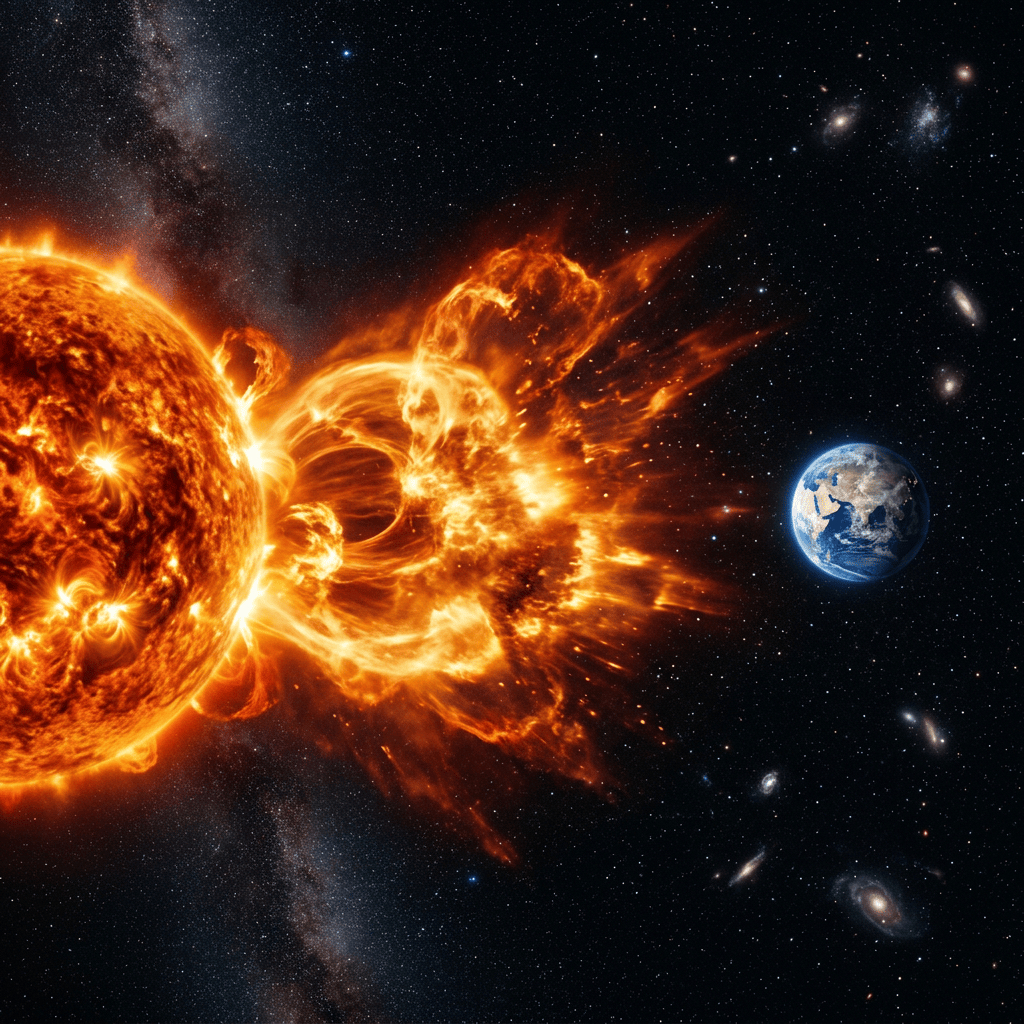
A colossal solar eruption streaks across space toward Earth against a star-filled backdrop.
Concise Takeaway
A powerful solar storm is forecast to strike Earth’s magnetosphere on 19th January 2026, with space‑weather agencies warning of possible G4‑level geomagnetic storm conditions (Kp8). The incoming disturbance is linked to a large coronal mass ejection (CME) launched from the Sun following an active solar region eruption.
Solar Storm Overview
Space‑weather monitoring centres reported that a fast‑moving CME is heading directly toward Earth. Models suggest the CME contains:
Strong magnetic fields
High‑speed solar plasma
Elevated cosmic‑ray modulation
Potential for significant geomagnetic disturbance
Arrival is expected late on 19th January 2026, with effects continuing into 20th January depending on solar‑wind conditions.
Expected Impact on Earth
If G4 (Kp8) conditions develop, the storm may cause:
A powerful solar storm is forecast to strike Earth’s magnetosphere on 19 January 2026, with space‑weather agencies warning of possible G4‑level geomagnetic storm conditions (Kp8). The incoming disturbance is linked to a large coronal mass ejection (CME) launched from the Sun following an active solar region eruption.
Solar Storm Overview
Space‑weather monitoring centres reported that a fast‑moving CME is heading directly toward Earth. Models suggest the CME contains:
Strong magnetic fields
High‑speed solar plasma
Elevated cosmic‑ray modulation
Potential for significant geomagnetic disturbance
Arrival is expected late on 19 January 2026, with effects continuing into 20 January depending on solar‑wind conditions.
Expected Impact on Earth
If G4 (Kp8) conditions develop, the storm may cause:
Technology & Infrastructure
Intermittent GPS inaccuracies
HF radio blackouts at high latitudes
Satellite drag due to atmospheric heating
Minor power‑grid fluctuations in vulnerable regions
Auroras
Auroras visible far south into mid‑latitude regions
Intensified displays across Canada, northern USA, UK, and northern Europe
Space Operations
Increased radiation exposure for satellites
Potential disruption to spacecraft orientation systems
Elevated risk for low‑Earth‑orbit missions
Scientific Context
Solar storms occur when charged particles and magnetic fields from the Sun interact with Earth’s magnetosphere. This event is notable because:
Solar Cycle 25 is approaching peak activity
CME speed is higher than average
Magnetic orientation may enhance geomagnetic coupling
Forecast models show strong potential for G‑class storming
G4 storms are significant but not rare during solar‑cycle peaks.
Monitoring Agencies
Global space‑weather organisations tracking the event include:
NOAA Space Weather Prediction Center (SWPC)
ESA Space Weather Office
UK Met Office Space Weather Operations Centre
NASA solar‑wind observatories
Japan’s NICT space‑weather division
Updates will continue as real‑time solar‑wind data becomes available.
Concise Takeaway
A powerful solar storm is forecast to strike Earth’s magnetosphere on 19 January 2026, with space‑weather agencies warning of possible G4‑level geomagnetic storm conditions (Kp8). The incoming disturbance is linked to a large coronal mass ejection (CME) launched from the Sun following an active solar region eruption.
Solar Storm Overview
Space‑weather monitoring centres reported that a fast‑moving CME is heading directly toward Earth. Models suggest the CME contains:
Strong magnetic fields
High‑speed solar plasma
Elevated cosmic‑ray modulation
Potential for significant geomagnetic disturbance
Arrival is expected late on 19 January 2026, with effects continuing into 20 January depending on solar‑wind conditions.
Expected Impact on Earth
If G4 (Kp8) conditions develop, the storm may cause:
Technology & Infrastructure
Intermittent GPS inaccuracies
HF radio blackouts at high latitudes
Satellite drag due to atmospheric heating
Minor power‑grid fluctuations in vulnerable regions
Auroras
Auroras visible far south into mid‑latitude regions
Intensified displays across Canada, northern USA, UK, and northern Europe
Space Operations
Increased radiation exposure for satellites
Potential disruption to spacecraft orientation systems
Elevated risk for low‑Earth‑orbit missions
Scientific Context
Solar storms occur when charged particles and magnetic fields from the Sun interact with Earth’s magnetosphere. This event is notable because:
Solar Cycle 25 is approaching peak activity
CME speed is higher than average
Magnetic orientation may enhance geomagnetic coupling
Forecast models show strong potential for G‑class storming
G4 storms are significant but not rare during solar‑cycle peaks.
Monitoring Agencies
Global space‑weather organisations tracking the event include:
NOAA Space Weather Prediction Center (SWPC)
ESA Space Weather Office
UK Met Office Space Weather Operations Centre
NASA solar‑wind observatories
Japan’s NICT space‑weather division
Updates will continue as real‑time solar‑wind data becomes available.
Related
Discover more from
Subscribe to get the latest posts sent to your email.