Physical Address
304 North Cardinal St.
Dorchester Center, MA 02124
Physical Address
304 North Cardinal St.
Dorchester Center, MA 02124

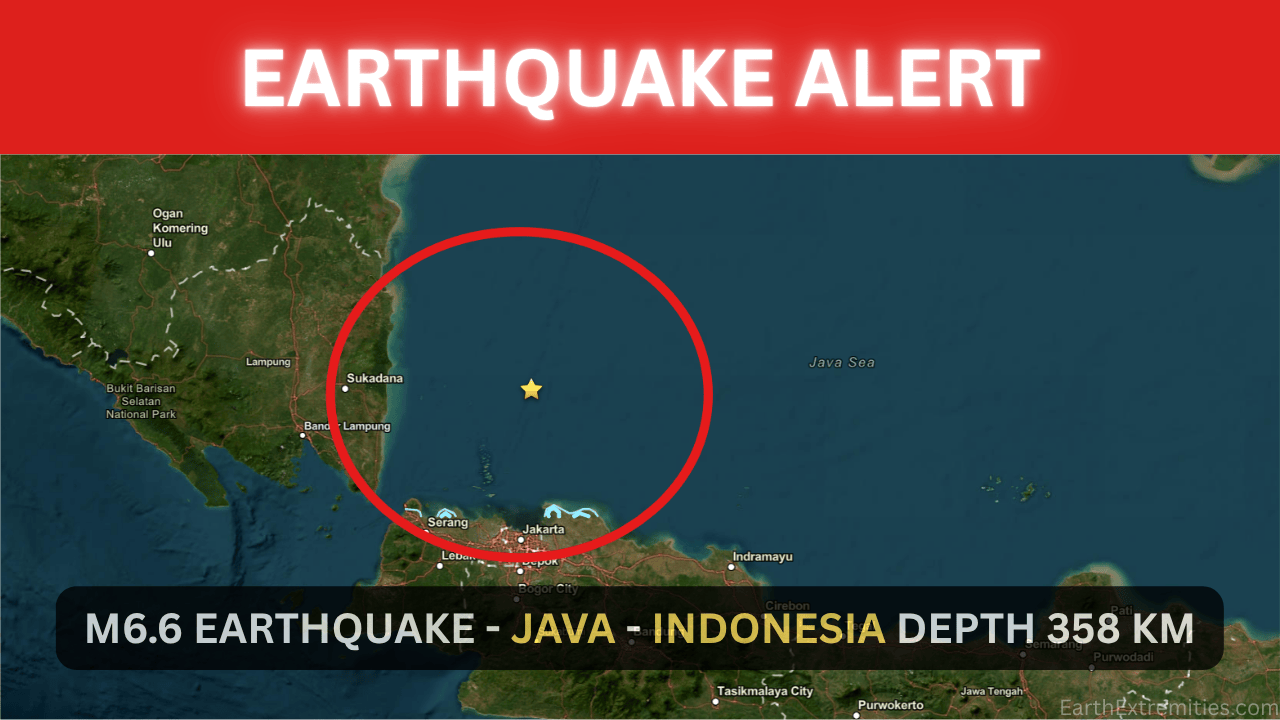
A magnitude 6.6 earthquake struck Java, Indonesia on 11th September 2026, according to data from the United States Geological Survey (USGS). The earthquake occurred at a depth of 358 km, placing it firmly within the category of deep-focus seismic events. Earthquakes at this depth rarely cause surface damage, but they can be felt across extremely wide areas due to the way seismic waves travel through the mantle.
Java sits within one of the most active tectonic regions on Earth — the Sunda Arc, where the Indo-Australian Plate is subducting beneath the Eurasian Plate. This ongoing tectonic collision produces frequent earthquakes ranging from shallow crustal events to very deep mantle quakes like this one.
Despite its large magnitude, the earthquake’s 358 km depth significantly reduced the likelihood of surface damage. Deep earthquakes typically produce:
Residents across parts of Central Java, West Java, Jakarta, and even Bali may have felt light shaking or brief swaying. Deep-focus earthquakes often generate a “rolling” sensation rather than sharp jolts.
No immediate reports of damage or casualties were issued, which is consistent with the earthquake’s depth and offshore location.
Java lies along the Sunda Arc, a major subduction zone responsible for:
Deep earthquakes like this one originate within the descending Indo-Australian Plate, far beneath the Earth’s crust. These events help scientists understand how the plate behaves as it sinks into the mantle.
Earthquakes deeper than 300 km are classified as deep-focus events. They are scientifically important because they:
The 6.6 event on 11th September 2026 fits this pattern, offering valuable data for regional and global seismic monitoring.
Subscribe to get the latest posts sent to your email.
