Physical Address
304 North Cardinal St.
Dorchester Center, MA 02124
Physical Address
304 North Cardinal St.
Dorchester Center, MA 02124

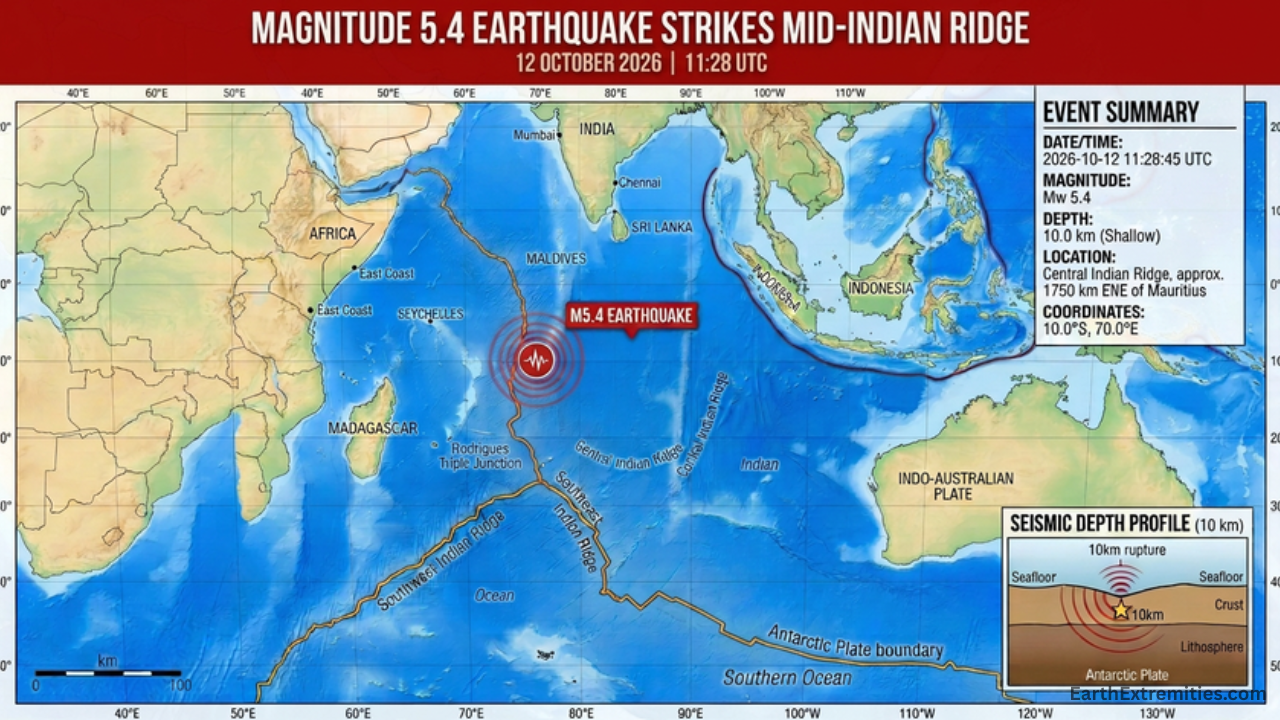
A magnitude 5.4 earthquake struck the Mid‑Indian Ridge on 12th October 2026, according to the United States Geological Survey (USGS). The quake occurred at a depth of 10 km, classifying it as a shallow‑focus event, which typically produces stronger surface shaking than deeper quakes.
The Mid‑Indian Ridge is part of the vast underwater mountain system that divides the Indian Ocean basin. Earthquakes here are usually linked to tectonic plate movement between the African, Indo‑Australian, and Antarctic plates, where spreading and faulting occur along the ridge.
The Mid‑Indian Ridge forms a crucial segment of the global mid‑ocean ridge network. It’s an area of divergent plate boundaries, meaning the plates are moving apart and new crust is being created. While most quakes in this region happen far from populated areas, they are vital for understanding seafloor spreading and plate dynamics beneath the Indian Ocean.
This event adds to a series of moderate‑magnitude quakes recorded along the ridge in recent months, highlighting ongoing tectonic activity across the oceanic crust.
Although no tsunami warnings were issued, shallow quakes of this magnitude can generate minor disturbances in the surrounding ocean floor. Scientists continue to monitor the region for aftershocks and further seismic movement.
Given the remote oceanic location, no immediate reports of damage or injuries have been received. However, such events are closely tracked by global seismic networks to ensure early detection of any potential ripple effects toward coastal areas.
The Mid‑Indian Ridge remains one of the most geologically active underwater zones, contributing to the slow but constant reshaping of Earth’s crust.
This earthquake serves as another reminder of the dynamic nature of Earth’s tectonic system. Each event along the ridge helps researchers refine models of plate motion, mantle convection, and crustal formation.
Continuous monitoring by agencies like USGS and EMSC ensures that even remote seismic activity contributes to the broader understanding of global geology.
Subscribe to get the latest posts sent to your email.
