Physical Address
304 North Cardinal St.
Dorchester Center, MA 02124
Physical Address
304 North Cardinal St.
Dorchester Center, MA 02124

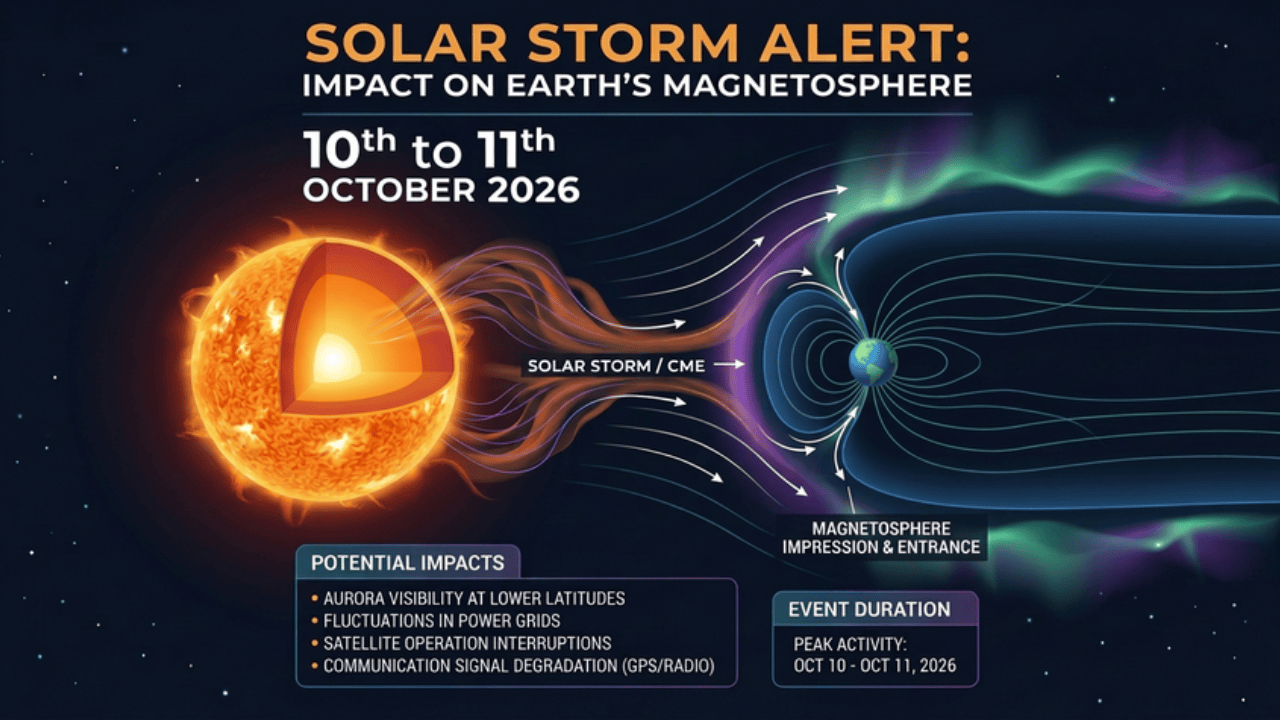
A solar storm is forecast to impact Earth’s magnetosphere between 10th and 11th October 2026, according to data from NOAA and the Space Weather Prediction Center (SWPC). The incoming disturbance is linked to recent solar activity involving coronal mass ejections (CMEs) and enhanced solar wind streams that have been travelling toward Earth over the past 48 hours.
This event may trigger geomagnetic storm conditions, potentially affecting satellite operations, radio communications, GPS accuracy, and producing visible auroras at higher latitudes.
NOAA and SWPC observations indicate that the storm is associated with:
These factors combined make geomagnetic disturbances more likely as the solar material interacts with Earth’s magnetic field.
NOAA’s early modelling suggests the storm may reach G1 to G2 levels, depending on how strongly the IMF couples with Earth’s magnetosphere.
Solar storms often arrive with some variability, so the exact timing may shift slightly depending on solar wind speed fluctuations.
Earth’s magnetosphere acts as a protective shield against solar radiation. When a solar storm arrives, the magnetic field becomes disturbed, allowing charged particles to penetrate deeper into the atmosphere. This can create beautiful auroras but also cause temporary disruptions to technology that relies on stable electromagnetic conditions.
With the Sun currently in a more active phase of its 11‑year cycle, events like this are becoming more frequent.
Solar storms of similar strength have previously produced:
This upcoming event is considered moderate, not extreme, but still noteworthy for space weather watchers and those tracking geomagnetic activity.
Subscribe to get the latest posts sent to your email.
