Physical Address
304 North Cardinal St.
Dorchester Center, MA 02124
Physical Address
304 North Cardinal St.
Dorchester Center, MA 02124

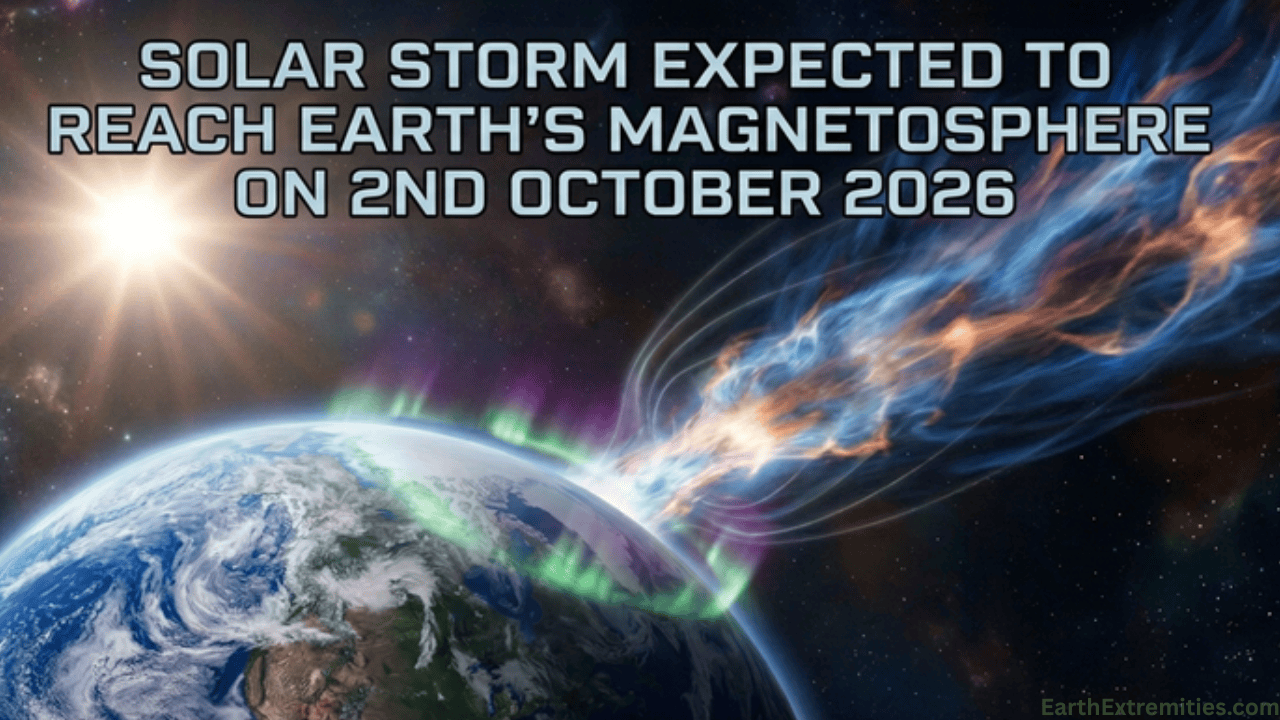
A solar storm is forecast to reach Earth’s magnetosphere on 2nd October 2026, according to updated alerts from NOAA and the Space Weather Prediction Center (SWPC). The incoming disturbance is linked to a recent coronal mass ejection (CME) launched from the Sun’s surface, sending a fast‑moving stream of charged particles toward Earth.
Space‑weather agencies report that the CME is expected to trigger geomagnetic activity, potentially affecting radio communications, satellite operations, and aurora visibility. While this event is not classified as severe, it is significant enough for monitoring networks worldwide to track its progression closely.
The storm’s intensity will depend on the solar wind’s speed, density, and magnetic orientation as it interacts with Earth’s magnetic field.
NOAA and SWPC confirmed that the storm originated from:
Solar observatories detected the CME shortly after the eruption, allowing forecasters to model its trajectory and expected arrival window.
Although not extreme, the storm may produce:
Most impacts are expected to be mild and temporary, but monitoring will continue throughout the event.
Solar storms are part of the Sun’s natural 11‑year activity cycle. During active phases, CMEs become more frequent and can influence:
The 2nd October 2026 event is expected to be scientifically important but not dangerous, offering researchers another opportunity to observe geomagnetic behaviour during a moderate CME impact.
Subscribe to get the latest posts sent to your email.
