Physical Address
304 North Cardinal St.
Dorchester Center, MA 02124
Physical Address
304 North Cardinal St.
Dorchester Center, MA 02124

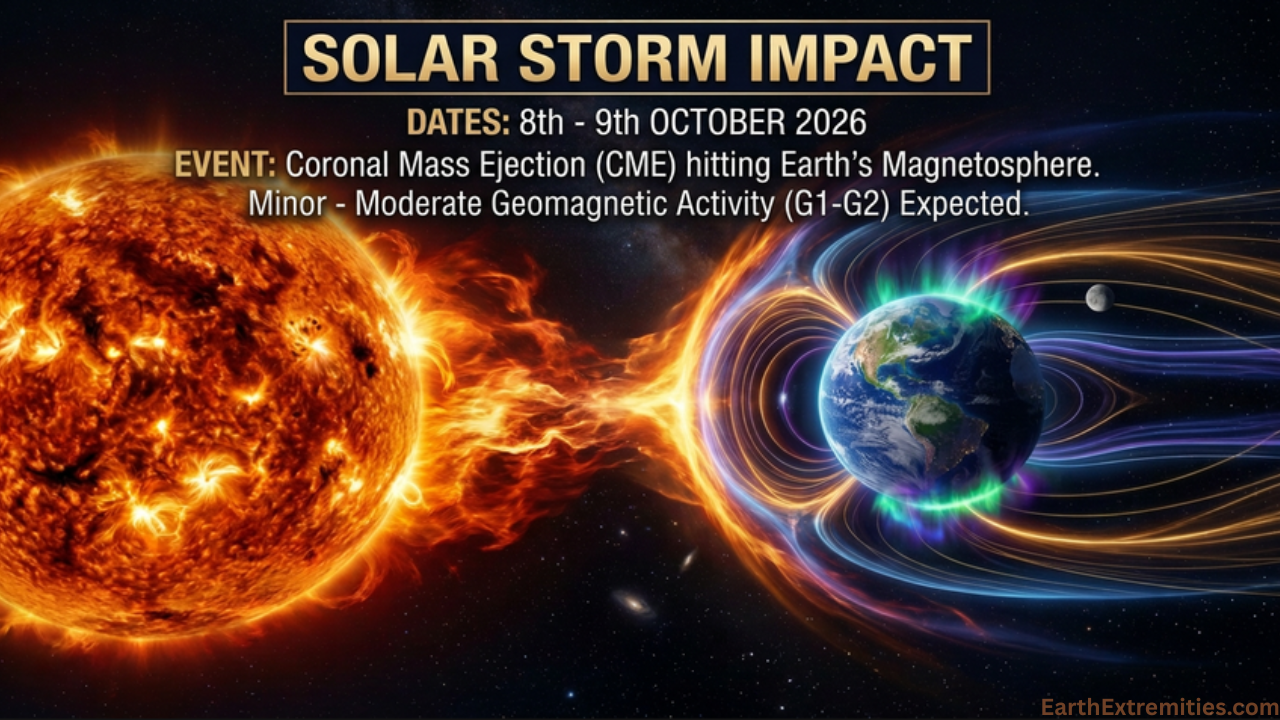
A significant solar storm is forecast to reach Earth’s magnetosphere between 8th and 9th October 2026, according to updated alerts from NOAA and the Space Weather Prediction Center (SWPC). Space‑weather scientists have been monitoring heightened activity on the Sun over the past several days, with a recent coronal mass ejection (CME) now confirmed to be Earth‑directed.
NOAA and SWPC data indicate that the incoming CME has the potential to cause geomagnetic disturbances, depending on its speed, density, and magnetic orientation when it arrives. Current modelling suggests a moderate to strong impact is possible, with forecasters watching closely for any late changes that could intensify the event.
The solar storm is expected to interact with Earth’s magnetosphere during the two‑day window, potentially triggering geomagnetic storm conditions, auroras, and temporary disruptions to certain technologies.
If the CME arrives with a southward‑pointing magnetic field — the orientation most likely to cause strong interaction — the following effects may occur:
The Sun is currently in a highly active phase of Solar Cycle 25, producing more frequent CMEs, solar flares, and magnetic eruptions. Events like this help scientists better understand how solar activity affects Earth’s systems and improve forecasting models for future storms.
This particular CME is notable because of its direct trajectory and the timing of its arrival, which falls within a period of elevated solar activity. Space‑weather agencies worldwide will be monitoring the storm closely as it approaches.
NOAA and SWPC will continue issuing updates as new data becomes available. Forecasts may shift depending on real‑time solar wind measurements taken by satellites such as DSCOVR and ACE. If the storm intensifies, additional alerts will be released to aviation, maritime, and communications sectors.
For the general public, the most visible effect may be enhanced auroras — a reminder of the powerful and dynamic relationship between the Sun and Earth.
Subscribe to get the latest posts sent to your email.
