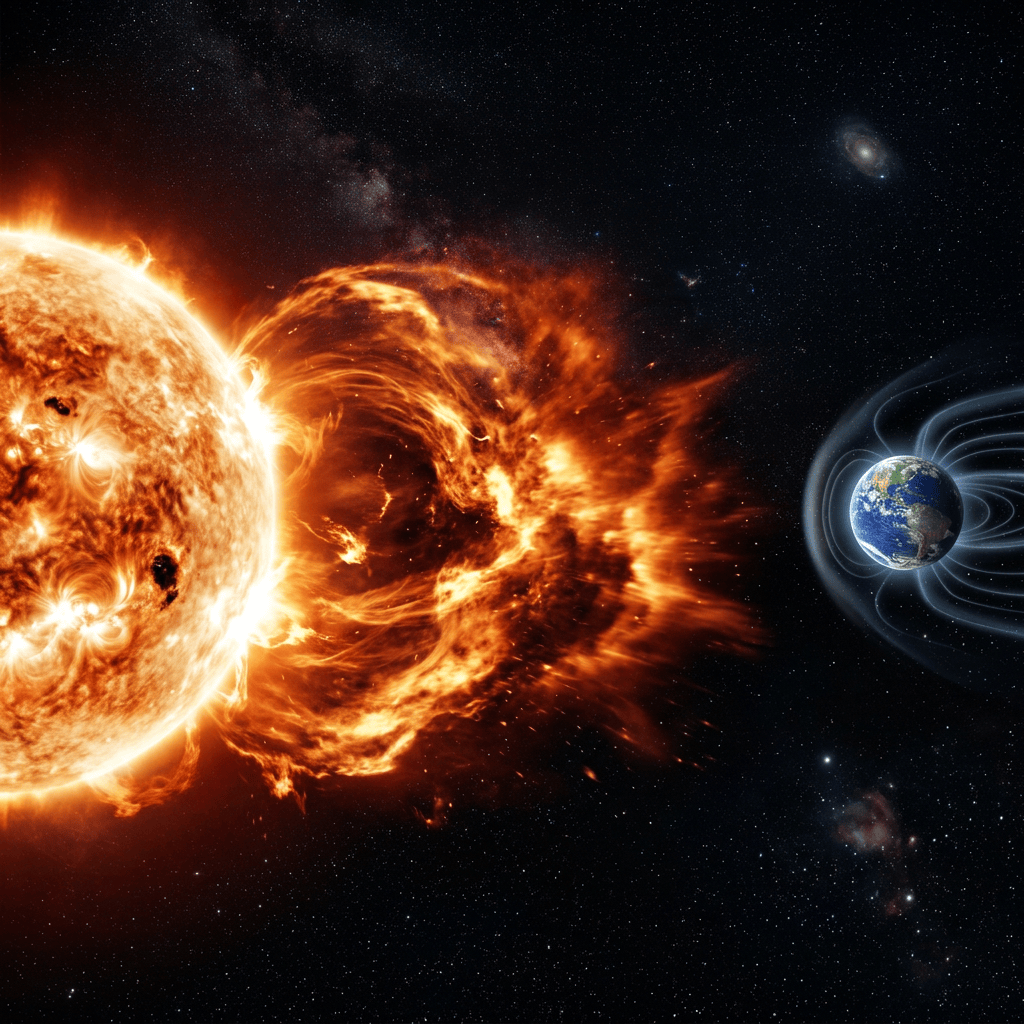
Solar eruption sending fiery plasma toward Earth’s magnetic field
A fiery solar eruption races toward Earth, illustrating how the planet’s magnetic field deflects space weather.

Concise Takeaway

A massive solar storm is forecast to impact Earth’s magnetosphere on 10th October 2024, following a powerful coronal mass ejection (CME) launched from an active region on the Sun. Space‑weather agencies warn that the incoming CME could trigger strong geomagnetic storm conditions, potentially affecting satellites, communications, and power‑grid stability.

Related Solar Storm Event
Powerful Solar Storm

Solar Storm Overview

Space‑weather monitoring centres detected a large CME erupting from the Sun, travelling at high speed toward Earth. Forecast models indicate the CME contains:

  • Dense solar plasma
  • Strong magnetic fields
  • Elevated solar‑wind speeds
  • Potential for significant geomagnetic disturbance

Arrival is expected on 10th October 2024, with effects possibly continuing into 11th October depending on solar‑wind conditions.

Expected Impact on Earth

Technology & Infrastructure

If geomagnetic storming intensifies, possible effects include:

  • GPS signal degradation
  • HF radio blackouts at high latitudes
  • Satellite drag due to atmospheric heating
  • Minor power‑grid fluctuations in sensitive regions

Auroras

  • Auroras may become visible much farther south than usual
  • Strong displays expected across Canada, northern USA, UK, Scandinavia, and northern Europe

Space Operations

  • Increased radiation exposure for satellites
  • Potential disruption to spacecraft orientation systems
  • Higher risk for low‑Earth‑orbit missions

Scientific Context

Solar storms occur when charged particles and magnetic fields from the Sun interact with Earth’s magnetosphere. This event is notable because:

  • Solar Cycle 25 is in a highly active phase
  • The CME speed is above average
  • Magnetic orientation may enhance geomagnetic coupling
  • Forecast models show strong potential for G‑class storming

Large CMEs during solar‑cycle peaks are capable of producing widespread geomagnetic effects.

Related Guide
How Solar Storms Affect Earth’s Magnetosphere

Monitoring Agencies

Global space‑weather organisations tracking the event include:

  • NOAA Space Weather Prediction Center (SWPC)
  • ESA Space Weather Office
  • UK Met Office Space Weather Operations Centre
  • NASA solar‑wind observatories
  • Japan’s NICT space‑weather division

Real‑time solar‑wind data will determine the exact strength of the geomagnetic storm once the CME arrives.


Discover more from

Subscribe to get the latest posts sent to your email.

Leave a Reply

Discover more from

Subscribe now to keep reading and get access to the full archive.

Continue reading

Discover more from

Subscribe now to keep reading and get access to the full archive.

Continue reading